
Compare Lane County Property Values
Sort three numbers apart before comparing anything. Kansas often labels the appraiser's fair-market estimate as market value or appraised value. Assessed value applies the constitutional assessment level instead. A sale price reflects an actual transfer, and it may need deed or appraiser confirmation before you rely on it.
| Value type | What it means | Where it is recorded |
|---|---|---|
| Appraised or market value | County estimate of fair market value, except use-valued land | Appraiser record |
| Assessed value | Appraised value multiplied by the applicable Kansas level | Appraisal and tax records |
| Last sale price | Consideration tied to an actual transfer when reported | Recorded deed or Appraiser file |
Differing figures are not errors. Each number measures a separate thing under its own dates, classes, and rules, and the Kansas Department of Revenue value explanation spells out the state's own definitions.
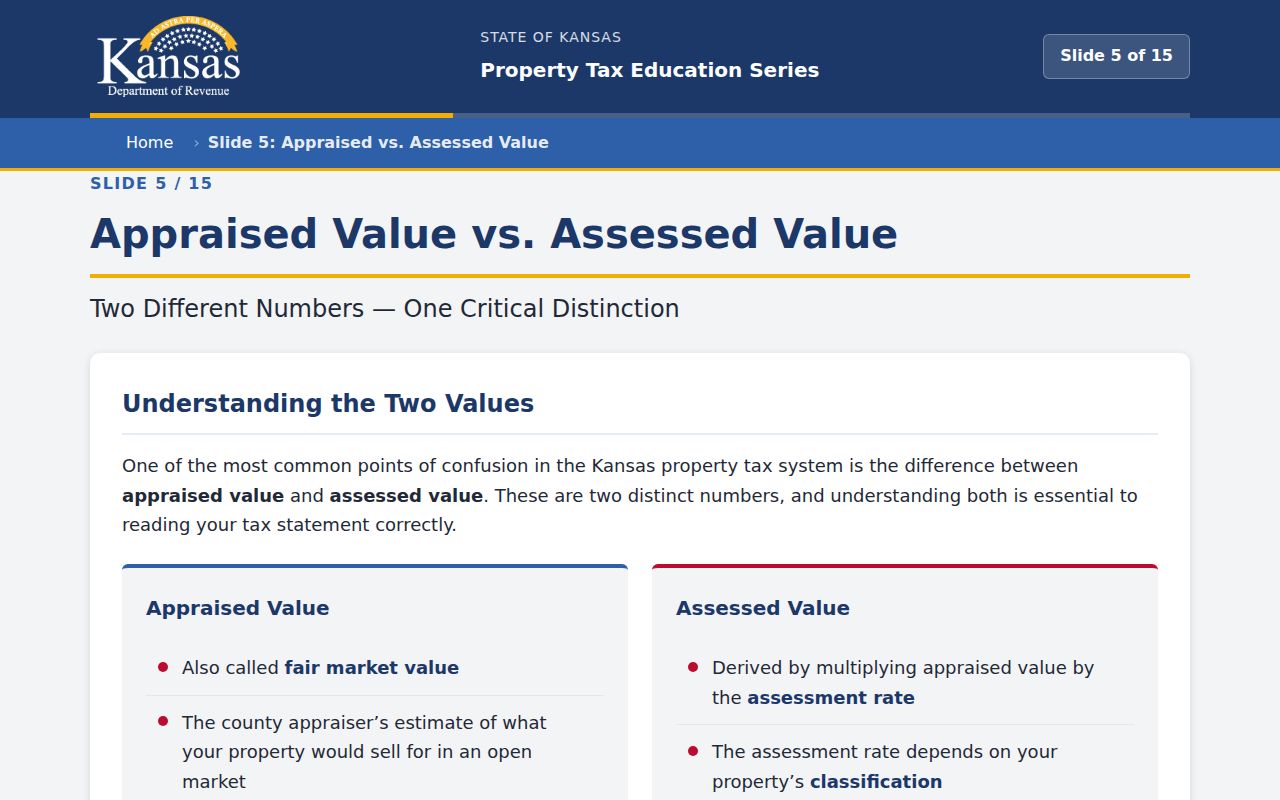
The state figures explain why an assessment level matters when reading any assessed value on a Lane County tax bill.
Read Lane County's Appraised Amount
In the LGIS result grid, the visible value field is labeled Apr Amount. It sits beside owner information, the property address, legal description, parcel ID, and class. The online grid shows no land-and-improvement split, sketch, or value history. Treat those items as unavailable until the Appraiser confirms them. Timing matters here too. The portal states that appraised-value figures are current-year data. Tax information rests on a prior assessed-value cycle. Save the year with any figure.
Apply Kansas Assessment Levels
Kansas sets a different constitutional assessment level for each property class. Residential real property is assessed at 11.5 percent of appraised value. Commercial and industrial real property is assessed at 25 percent. Vacant lots sit at 12 percent. Agricultural land runs at 30 percent of its use value. So one market estimate can produce different assessed amounts. Verify the class in the Lane County parcel record before calculating anything.
Estimate Lane County Recorded Value
Use the Lane County Appraiser and LGIS portal to pull up a single parcel, then read the value alongside its class and year. Never copy a number from a neighboring row.
- Search the address, owner, parcel ID, or Quick Ref ID.
- Confirm legal description and class before reading Apr Amount.
- Record the year and ask the Appraiser for fields not visible in the grid.
- Check a reported sale against the deed or Appraiser file.
- Assessed value
- The amount after the assessment level is applied.
- Market value
- An estimate of fair market value.
- Assessment level
- The class percentage used to derive assessed value.
- Consideration
- The value stated for a transfer when recorded.
- Reappraisal
- A new appraisal for a later valuation cycle.
For tax bills and appeals, use the Lane County property tax records page.
Separate Lane County Agricultural Value
Lane County values agricultural land by its economic use. It does not lean on nearby home sales for comparison. That matters across the county's farm and ranch country. A house sale next door tells you little here. It says almost nothing about a working parcel's worth on the tax roll.
Check the land class and the acreage before drawing conclusions. Buildings and other improvements can carry their own valuation treatment. That treatment stays separate from the farm land beneath them in the property records.
Verify Lane County Sale Evidence
The online result grid shows no sale date or price. Don't guess at a portal field. For a transfer record, ask the Appraiser or the Register of Deeds. A deed's consideration needs context. It does not by itself establish present market value. Family transfers, estate transfers, and partial-interest deals may look nothing like an open-market sale.
Use Kansas Ratio Studies Carefully
Kansas ratio studies compare appraised value with sale price. The Kansas ratio-study index supplies definitions and reports. A ratio describes the appraisal system, though, not any single Lane County parcel, so check the reports before quoting a Dighton figure.
Check Lane County's 2026 Trend
The county Appraiser page links a 2026 Trend Publication. Read it before quoting any Dighton percentage. Its very presence is a prompt to confirm the valuation year behind every figure you use. LGIS advertises Thursday updates. Even so, appraisal and tax cycles can still differ, so date every comparison.
Request Lane County Value Details
When the public detail view fails, call the Lane County Appraiser at 620-397-2804. The county lists a $1 property record card fee. Give staff the address, parcel ID, Quick Ref ID, legal description, class, and the valuation year you need. A focused request works best. It can confirm an existing land or improvement field without asking anyone to estimate a sale price. K.S.A. 45-219 and 45-220 govern inspection, copies, actual-cost fees, and public-record request procedures. Neither statute requires a custom appraisal.
Compare Lane County Value Classes
Dighton Main Street results mix residential, commercial and industrial parcels, and exempt parcels. Appraised amounts vary row to row. That spread is exactly why a raw block average can mislead. A veterans' post, a cooperative facility, a vacant lot, and a house can all sit near each other. Each follows different classification and taxable-treatment rules. Compare like with like. Keep the valuation year fixed, too. Class is a clue, not proof of current physical use. If an exemption or classification seems unclear, request the underlying Appraiser record. Do not infer it from an owner name.
Limit Lane County Value Conclusions
An assessed value exists to support tax administration. It is not the price a parcel will bring. Nor is it a licensed appraisal, survey, title opinion, or tax bill. Exempt status can change taxable treatment without ever stating what the land is worth, as the exempt VFW sample shows.
Value versus price. Lane County assessed value is not a sale forecast. Obtain a qualified appraisal when a transaction depends on present market value.
Value, ownership, boundaries, and tax status are separate questions. The custodian behind one number may not hold the others.
Test a Lane County Value Comparison
Four numbers get confused constantly in Lane County: appraised value, assessed value, the tax amount, and the consideration shown on a deed. None of them mean the same thing. The portal's "Apr Amount" is not a tax bill. Kansas assessment levels turn appraised or use value into an assessed amount by class, and levies decide the tax after that. A deed figure can come from a family transfer, an estate, or a partial-interest sale, so it may look nothing like an open-market price.
Dighton's published samples need context before they mean much. A few selected 2026 Main Street rows ran from $24,020 up to $101,960. But the set mixed residential, commercial, industrial, and exempt property. Some rows covered several platted lots at once. Without class, acreage, improvements, lot count, and sale conditions, comparing the high and low figures will not produce a sound property value estimate.
For a time series, request earlier property cards and read the county's linked 2026 trend publication before quoting any change. The publication exists, though its percentages still have to be read directly from the document. Kansas ratio studies supply countywide and class-level context, not a Dighton-specific appraisal. Always cite the valuation year and the source. That way the comparison can be repeated by anyone.
Agricultural property adds one more distinction. Kansas values agricultural land by its economic use. Assessment treatment then differs by class. Confirm land class, acreage, and how improvements are handled with the Appraiser. A residence, a grain facility, a vacant lot, and a farm tract can sit near each other in Lane County while following entirely different valuation rules.
Record Lane County Value Sources
A good value worksheet labels every number. Give each figure a year, a class, and a source. Copy the portal's appraised amount exactly. Calculate an assessed figure only with the verified Kansas class rate. Keep the tax statement amount in its own column. Add a deed consideration figure only when the recorded instrument actually supplies it. Note the transfer type alongside it. For an appeal or a purchase decision, hold onto the property card, the trend publication, and any professional appraisal. Keep each of these as separate pieces of evidence. That format keeps a current appraised amount, a prior tax cycle, and a nearby parcel figure separated. An old sale then can't be presented as if they measured the same thing.
Explain Lane County Value Changes
When a number moves, ask what moved it. The cause might be a new appraisal year, a class change, a parcel split, an added improvement, or simply a different source. Record that answer rather than labeling every shift market appreciation, and keep the year and property class beside each amount.